New Year's Day

1 January 2026 Retail mostly closed Nationwide Falls on: Thursday

1 January marks the start of the new year and is a statutory public holiday throughout Austria. Here you will find the key information on public-holiday rest, typical opening hours, bridge days and the best-known New Year's customs.

Practical

At a glance

New Year's Day falls this year on Thursday, 1 January 2026 and is a nationwide statutory public holiday. Public-holiday rest, substitute holidays, typical opening hours and bridge days are summarised at a glance.

Date
1 January 2026
Falls this year on Thursday.
Status
Nationwide public holiday
Holiday rest is the statutory default.
Weekend
No substitute public holiday
No automatic replacement day when it falls on Saturday or Sunday.
Bridge days
4 free days
1 day(s) of annual leave are enough this year for a longer block.

New Year's Day is one of the few public holidays that almost everyone in Austria notices at the same time: public offices, banks, schools, many offices and regular retail pause. But the day is not just a quiet calendar entry. It affects travel planning, rosters, opening hours, family routines and often the question of whether the turn of the year can become a short break.

In practical terms, the combination of date and weekday matters most. If 1 January falls on a Tuesday, Wednesday or Thursday, interesting bridge-day options appear around New Year's Eve and New Year's Day. If it falls on a weekend, New Year's Day remains a statutory public holiday, but generally no additional substitute public holiday is created.

Anyone who wants to plan the start of the year well should clarify three things early: which errands must still be completed before New Year's Eve, which businesses operate holiday hours, and whether one day of annual leave is worth using for a longer free block. After that, time off, travel, family visits and small New Year's gifts are much easier to organise.

Holiday planning

Calculate bridge days

How to optimally use 1 January to build a long winter break with few days of annual leave.

1 day of annual leave = 4 days

4 free days with 1 day of annual leave

With one day of annual leave, you can build a long weekend around New Year's Day.

Recommendation
Take Friday off
Block
1 January to 4 January 2026

The advantage is not only a single free day, but the combination with weekends, New Year's Eve, Epiphany and the rest of the public-holiday calendar. Anyone who reviews the whole annual leave year in January spots the best free blocks before team and family calendars fill up.

The calculator lets you check directly whether New Year's Day can become a longer weekend, a thermal-spa stay, a ski holiday or a quiet family visit. Annual leave or time off in lieu still has to be coordinated; a bridge day is not an additional public holiday.

Everyday life & Transport

Practical on 1 January

What you need to know about closed shops, public transport and leisure activities.

In everyday life, New Year's Day is less complicated than Christmas, but clearly different from a normal working day. 1 January is a statutory public holiday, so most regular shops remain closed. Many people only notice this when groceries, medicine, cash or travel supplies are still missing. A sober preparation helps: complete everything necessary by New Year's Eve and expect only exceptions on the public holiday.

At the same time, New Year's Day is often an active day in tourism regions. Ski areas, thermal spas, hotels, excursion destinations and some restaurants use the start of the year as an important holiday-period day. That is the key difference: normal retail rests, but leisure and tourism offers can be very relevant. Opening hours should still be checked directly with the provider because public-holiday operation, holiday-period operation and regional season times overlap.

Transport

Public-holiday schedule

Public transport usually runs according to Sunday or public-holiday timetables. Anyone travelling early should check local transport networks and special schedules directly.

Shopping

Mostly closed

Regular supermarkets and many retail shops remain closed. Typical exceptions are travel-supply locations at railway stations or airports.

Banks and administration

Delayed

Branches and many public offices remain closed. Transfers, bookings and administrative errands can shift because of the public holiday.

Leisure

Often open

Ski areas, thermal spas and tourist destinations often open normally or with public-holiday hours. In holiday regions, the day-specific information matters.

Legal situation

Labour law

Why New Year's Day is a statutory public holiday and what rules apply to working on this day.

Under labour law, New Year's Day is clearly classified: 1 January is a statutory public holiday throughout Austria under section 7 of the Working Rest Act. For employees, this generally means a right to public-holiday rest and public-holiday pay. The day is therefore not a voluntary rest day set by the company, but part of the statutory public-holiday order. [1]

Exceptions exist where public-holiday work is legally permitted, for example in certain areas of healthcare, care, transport, safety, restaurants, hotels or seasonal tourism. Whether and how work is allowed depends not only on the public holiday itself, but also on the Working Rest Act, working-time rules, roster, sector and collective agreement. Supplements, substitute rest or company-specific rules should therefore always be checked for the specific job and employer.

A frequent confusion with bridge days is also important. A bridge day between a public holiday and a weekend is not a statutory public holiday. It can become free through annual leave, time off in lieu, a workplace agreement or a company closure rule. Without such a basis, it remains a normal working day.

Nationwide public holiday

1 January is a statutory public holiday throughout Austria under section 7 of the Working Rest Act.

No substitute public holiday

If New Year's Day falls on Saturday or Sunday, it generally does not create an automatic additional free working day.

Public-holiday work

Work on a public holiday is possible only in areas provided by law; details and supplements often depend on the collective agreement.

FAQ

Häufig gestellte Fragen

Is there a substitute public holiday if New Year's Day falls on a weekend?

No. In Austria, there is generally no automatic substitute public holiday for 1 January if New Year's Day falls on a Saturday or Sunday.

Are supermarkets such as Billa, Spar or Hofer open on 1 January?

Regular supermarkets are generally closed on 1 January. Exceptions exist only at individual travel-supply locations at railway stations or airports.

Do I have to work on New Year's Day if my workplace is open?

In principle, statutory public holidays are days of rest. Exceptions are permitted only in legally regulated areas. If you work, you receive pay for the hours worked in addition to public-holiday pay; further supplements often depend on the collective agreement.

May ski areas, thermal spas and excursion destinations open on 1 January?

Many tourism businesses are open on 1 January, either normally or with public-holiday hours. You should check opening hours directly with the provider.

Why do people in Austria wish each other einen guten Rutsch?

The phrase has nothing to do with slipping. Linguistically, it is usually traced to the Yiddish word Rosh for beginning or head. It means a good start to the new year.

Background and customs

The background explains history, culture, superstition, food traditions and environmental questions around the Austrian start of the year.

Historical context

History and origins

How 1 January became the civil start of the year from the Roman calendar through church feast order.

The designation of 1 January as New Year's Day is not accidental, but part of a long calendar history. In ancient Rome, the start of the year was at times placed differently. With the calendar reform in 45 BC, Julius Caesar set 1 January as the beginning of the civil year. The month of January refers to Janus, the Roman god of transitions, doors and beginnings. That already contains the symbolism still felt today: looking back, closing one chapter and looking ahead.

In Christian Europe, however, the beginning of the year remained inconsistent for a long time. Depending on region, territory and church tradition, Christmas, Easter, 25 March or other dates could count as the start of the year. Only gradually did 1 January establish itself in administration and everyday life. For Austria, this history is interesting because New Year's Day today is both a modern state public holiday and a day with religious, cultural and family traces.

From a Catholic perspective, 1 January is also the Solemnity of Mary, Mother of God. This religious meaning is often not foregrounded in everyday life, but it explains why the day is more than just the first entry in the calendar. It marks a transition that is visible at the same time in administration, school, work, media and family rituals.

Culture

Culture and TV highlights

From the Musikverein to TV routines and a quieter family rhythm on the first day of the year.

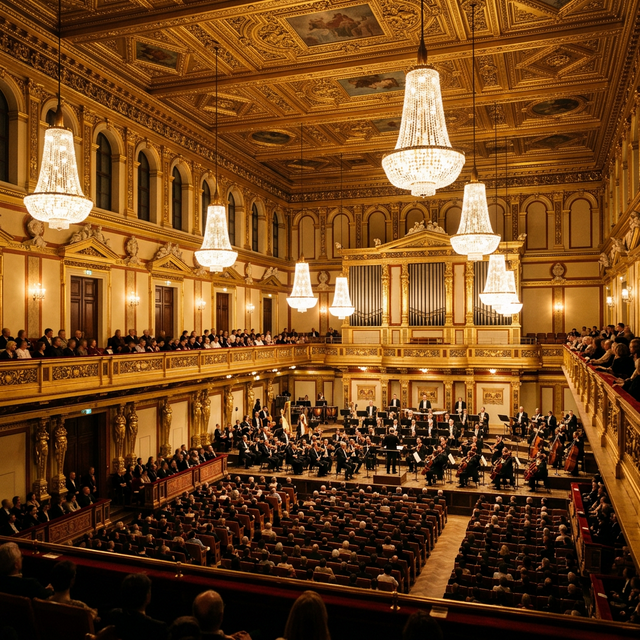
Golden Hall of the Vienna Musikverein during the New Year concert

In Austria, New Year's Day is also a media day. While New Year's Eve is loud, private and often late, 1 January has a quieter rhythm. Many households start later in the morning, eat together, let the old year fade out and follow familiar broadcasts. This repetition is exactly what makes the day culturally familiar: nothing new has to be learned; the start of the year is recognised through familiar sounds, images and routines.

The best-known ritual is the New Year's Concert of the Vienna Philharmonic from the Golden Hall of the Vienna Musikverein. It is broadcast internationally and connects Austria's cultural image with waltzes, polkas and festive staging. For many people, the concert is less a conventional concert date than a sign: the turn of the year has truly arrived in everyday life.

The New Year's Concert

The morning is traditionally shaped by the Vienna Philharmonic in the Golden Hall of the Musikverein.

Address and start of the year

Reviews, year previews and the Federal President's address give the day a quieter tone.

Folk belief

Superstitions and Alpine myths

Why the chimney sweep brings luck and what role the Rauhnaechte play at the turn of the year.

Mystical Rauhnacht atmosphere in an Austrian alpine village

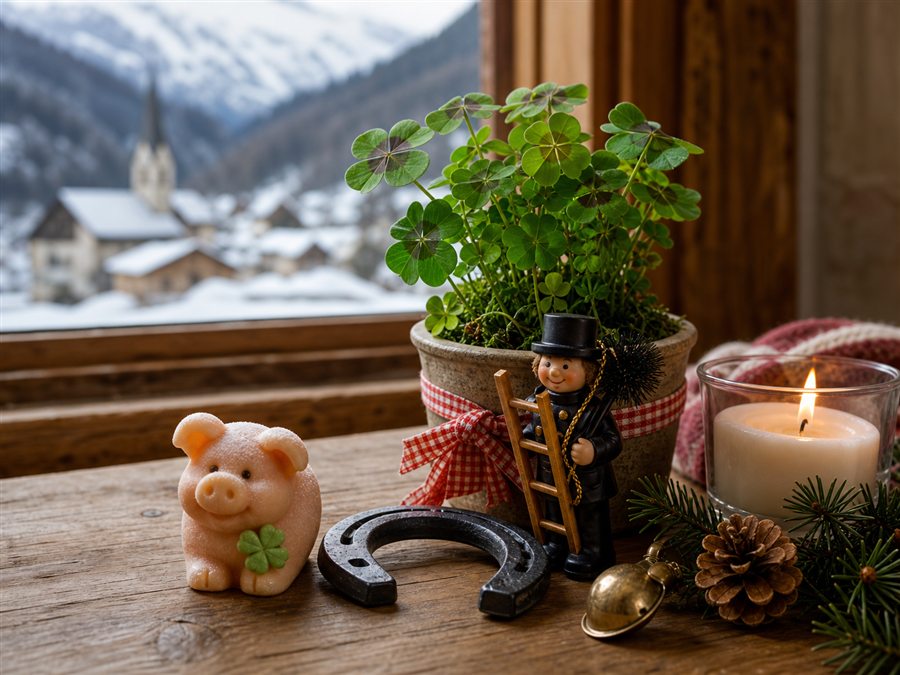
Around New Year's Day in Austria, many small good-luck and transition rituals overlap. They range from the chimney sweep and cloverleaf to lucky pigs, coins, lentils and good wishes. Such customs are rarely strictly religious or legally relevant, but they give the day emotional meaning. The turn of the year is a moment when people want to bring order to the future even though nobody knows what will come.

Especially in Alpine regions, New Year's Day is often seen in the wider frame of the Rauhnaechte. This means the period between Christmas and 6 January, when folk belief, household rituals and stories play a larger role. Many of these ideas are now more cultural heritage than lived rule, but they continue to appear in families, tourism, media and regional events.

Rauhnaechte

In folk belief, these nights are considered a transition period. Smoking out the house is meant to symbolically make space for the new year.

Interpreting dreams

A widespread myth gives dreams on New Year's night special meaning for the months ahead.

Good-luck charms as gift ideas

The small symbols around New Year's Day are often given at short notice, are easy to get and work well as greetings for family, friends, colleagues and neighbours.

Chimney sweep

A classic good-luck symbol for protection, a fresh start and a clean beginning to the year.

Cloverleaf

The four-leaf clover stands for luck and is often given as a small plant, decoration or New Year's greeting.

Lucky pig

Typical as marzipan, chocolate, a gift set or a small token for the turn of the year.

Silver fish

A small talisman for prosperity, money flow and symbolic New Year's gifts.

Seasonal dishes

Food traditions

From the lucky pig to the New Year's plaited loaf: what is typically eaten on 1 January.

Traditional Austrian New Year meal with lucky dishes

In culinary terms, New Year's Day is less fixed than Christmas, but several motifs return again and again in Austria. Many dishes revolve around luck, prosperity, moving forward or simply recovering after a long New Year's Eve. That makes New Year's food pragmatic: it can be festive, but it does not have to be. A quiet breakfast, a hearty meal in the afternoon or an uncomplicated visit to a hotel restaurant all fit the day.

The pig is especially well known as a symbol of luck. In custom, it stands for forward movement because it roots forward with its snout. Lentils, beans or rice are often associated with money and abundance. The New Year's plaited loaf, by contrast, stands more for continuity and community. After New Year's Eve, very simple foods also appear: sour, salty, cool and easy to prepare. Realistically, that is part of 1 January too.

Roast pork

The pig symbolises moving forward. Lentils, beans or rice are often associated with prosperity.

New Year's plaited loaf

Plaited loaves or pretzels stand for health and continuity through their closed form.

Hangover breakfast

Rollmops, herring spread or sour sausage belong to the pragmatic side of New Year's food.

Rules & Alternatives

Environment and safety

What you should know about fireworks, safety and quieter alternatives.

Fireworks continue to shape the debate around the turn of the year. On 1 January this is not only about tradition, but also about noise, litter, particulate matter, animals and safety questions. For many people, the public holiday therefore starts with cleaning up, careful walks, consideration for pets or the question of which pyrotechnics rules actually apply.

The legal baseline is clearer than many discussions suggest: fireworks in category F2 are generally prohibited year-round in built-up areas. Municipalities can permit exceptions, but must consider danger, noise and local circumstances. This means that even around New Year's Eve and New Year's Day, not everything is automatically allowed. Anyone using fireworks should check local rules and show consideration for people, animals and surroundings. [5]

At the same time, the culture of the turn of the year is changing. Cities, organisers and tourism businesses increasingly use more controllable alternatives such as light shows, laser shows or drone shows. For families, pet owners and guests, this is often easier to plan because noise, closures, start time and the way home are more clearly managed.

F2 in built-up areas

F2 fireworks are generally prohibited year-round in built-up areas.

Exceptions

Municipalities can allow exceptions, but only if no danger or unreasonable noise nuisance is expected.

Penalties

Administrative penalties of up to 3,600 euros are possible for violations.

Next steps

Plan next

Tools and links to efficiently plan the rest of the public-holiday year.

Quellen & Weiterführendes

  1. RIS - Working Rest Act section 7 : statutory holiday rest and list of nationwide public holidays in Austria.
  2. Chamber of Labour - public holiday rest : clear overview of rest periods, public-holiday pay and public-holiday work.
  3. Austrian Trade Union Federation - working on public holidays : compact classification of public-holiday work and collective-agreement supplements.
  4. Lower Austria Chamber of Labour - taking bridge days off : basic rules for annual leave or making up bridge days.
  5. oesterreich.gv.at - fireworks and New Year's Eve firecrackers : official rules on F2 fireworks in built-up areas, exceptions and penalties.
  6. New Year's Eve (31 December) : Everything about the evening before New Year's Day.
  7. Epiphany (6 January) : The following public holiday, which marks the end of the Rauhnaechte period.